
Whether you are planning a vacation to Paris, joining an international business meeting, or simply trying to call friends abroad, understanding the Paris time zone is essential. Time differences can affect flights, hotel check-ins, work schedules, and even restaurant reservations.
Paris follows Central European Time and also observes daylight saving time during part of the year. While the system may seem simple at first, many travelers become confused when clocks change in spring and autumn. This guide explains everything you need to know about the Paris time zone, including UTC offsets, daylight saving rules, time differences with major cities, and practical travel tips.
What Time Zone Is Paris In?
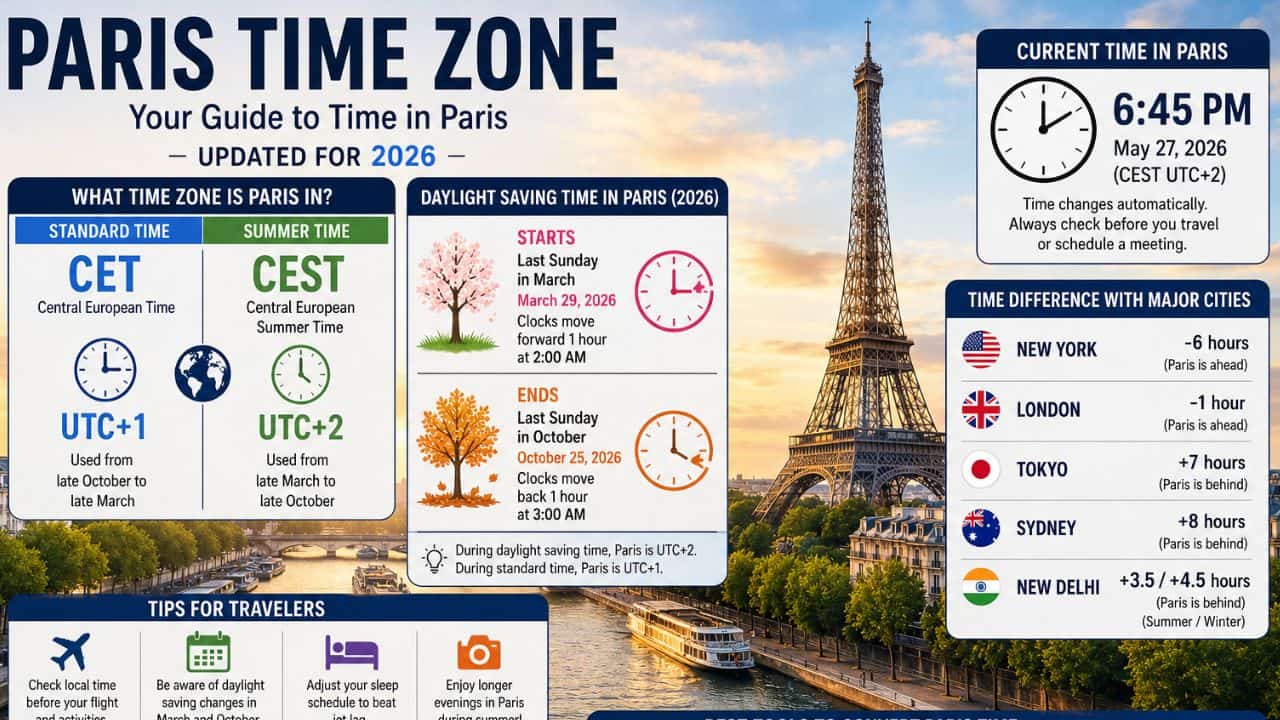
Paris uses Central European Time (CET) during the standard part of the year. The city is located in the Central European time region, which is shared by many countries across continental Europe.
Quick Facts About the Paris Time Zone
- Standard Time Zone: Central European Time (CET)
- UTC Offset During Standard Time: UTC+1
- Summer Time Zone: Central European Summer Time (CEST)
- UTC Offset During Summer: UTC+2
- Country: France
- Time Format Commonly Used: 24-hour clock
This means Paris is normally one hour ahead of Coordinated Universal Time (UTC) during winter and two hours ahead during summer daylight saving months.
Understanding CET and CEST
Many people notice two abbreviations connected with Paris time: CET and CEST. These refer to different parts of the year.
What is Central European Time (CET)?
Central European Time is the standard time used in Paris during autumn and winter.
UTC+1UTC+1
This means when it is 12:00 UTC, it is 1:00 PM in Paris.
CET is typically observed from late October until late March.
Countries that also use CET include:
- Germany
- Italy
- Spain
- Belgium
- Netherlands
- Poland
Because so many European nations share the same time zone, traveling between these countries is usually easy without adjusting clocks.
What is Central European Summer Time (CEST)?
During warmer months, Paris changes to Central European Summer Time.
UTC+2UTC+2
This daylight saving schedule gives people longer daylight hours in the evening. CEST is generally used from late March to late October.
For travelers, this means sunsets in Paris during summer can happen very late, often after 9:30 PM.
Why Paris Changes Clocks Twice a Year?
Like most European countries, France follows daylight saving time to make better use of natural daylight. The idea became widely adopted during the 20th century as a way to reduce energy usage.
The system works like this:
- In spring, clocks move forward one hour
- In autumn, clocks move backward one hour
Although discussions about ending daylight saving time occasionally appear in Europe, Paris still follows the seasonal clock change today.
When Does Daylight Saving Time Start and End in Paris?
Understanding daylight saving transitions is important for travelers booking flights or online meetings.
Start of Daylight Saving Time
In Paris, daylight saving time usually begins on the last Sunday in March.
At 2:00 AM, clocks move forward to 3:00 AM.
Benefits include:
- Longer evening daylight
- Later sunsets
- More outdoor activity time
Spring in Paris becomes especially enjoyable because cafés, parks, and river walks stay lively later into the evening.
End of Daylight Saving Time
Daylight saving time ends on the last Sunday in October.
At 3:00 AM, clocks move back to 2:00 AM.
This transition brings:
- Earlier sunsets
- Shorter daylight hours
- More winter-like evenings
Travelers visiting Paris during late autumn should prepare for darker afternoons and cooler temperatures.
Current Time in Paris
The easiest way to check the current time in Paris is through:
- Smartphone world clock apps
- Search engines
- Smartwatches
- Airline apps
- Hotel booking platforms
Most modern devices automatically adjust to Paris time once connected to local networks.
For international travelers, checking the current Paris time before boarding flights or attending events can prevent scheduling mistakes.
Paris Time Difference With Major Cities
Time differences become especially important for international communication and travel planning.
Paris vs New York
New York City is typically 6 hours behind Paris.
Example:
- 6:00 PM in Paris
- 12:00 PM in New York
However, daylight saving dates in Europe and the United States do not always change on the same weekend, so temporary differences may occur.
Paris vs London
London is usually 1 hour behind Paris.
Travelers often notice this immediately when taking the Eurostar train between the two capitals.
Paris vs Tokyo
Tokyo is generally 7 or 8 hours ahead of Paris, depending on daylight saving time.
This difference can make business communication challenging without careful planning.
Paris vs Sydney
Sydney often has a time difference of around 8 to 10 hours ahead of Paris because both regions observe daylight saving time at different times.
Paris vs India
India follows Indian Standard Time (IST), which is usually:
- 3 hours 30 minutes ahead of Paris during the summer
- 4 hours 30 minutes ahead during winter
This is useful for travelers and remote workers communicating between Europe and South Asia.
How does the Paris Time Zone Affect Travelers?
Time zones can significantly influence the overall travel experience.
Jet Lag Tips for Visitors
Long-haul travelers arriving in Paris often experience jet lag. Common symptoms include:
- Fatigue
- Difficulty sleeping
- Daytime drowsiness
- Reduced concentration
Helpful tips include:
- Adjust sleep schedules before departure
- Stay hydrated during flights
- Spend time outdoors after arrival
- Avoid heavy naps
Walking around neighborhoods like Montmartre or along the Seine River can help travelers adjust naturally to local time.
Planning Tours and Attractions
Knowing the local time helps visitors maximize sightseeing.
Popular attractions such as:
- Eiffel Tower
- Louvre Museum
- Notre-Dame Cathedral
often have different opening hours depending on the season.
Summer evenings in Paris stay bright for much longer, making nighttime river cruises and outdoor dining especially enjoyable.
Flight Connections and Airport Timing
Paris is home to major international airports, including:
- Charles de Gaulle Airport
- Orly Airport
Understanding local time prevents:
- Missed flights
- Incorrect airport transfers
- Hotel check-in confusion
Travelers should also verify whether flight times are listed in local departure time or arrival destination time.
Paris Time Zone for Remote Work and Business
Scheduling International Meetings
Paris is well-positioned between Asian and American business hours.
Good overlap periods include:
- Morning in New York
- Afternoon in Paris
- Evening in parts of Asia
Many global companies schedule international calls around Paris afternoon hours.
Digital Nomads in Paris
Remote workers living in Paris often appreciate the balance between European and global time zones.
Advantages include:
- Easy coordination with Europe
- Partial overlap with North America
- Late evening access to Asian markets
The city’s cafés and coworking culture also make it attractive for freelancers and entrepreneurs.
Stock Markets and Business Hours
France’s major financial activities generally operate according to Paris local time.
European business hours usually run:
- 9:00 AM to 5:00 PM or 6:00 PM
Travelers dealing with international banking or investments should pay close attention to Paris market hours.
Historical Background of Paris Time
Before standardized time zones existed, cities relied on local solar time based on the sun’s position.
As railway travel expanded across Europe during the 19th century, standardized time became necessary. France gradually adopted a unified system aligned with neighboring European countries.
Over time, Paris transitioned into the Central European Time system used today.
During different historical periods, including World War II, timekeeping rules in France changed several times before modern CET practices became standardized.
Common Mistakes People Make About Paris Time
Confusing Paris Time With GMT
Many travelers incorrectly assume Paris follows Greenwich Mean Time (GMT). In reality:
- Paris is UTC+1 in winter
- Paris is UTC+2 in summer
Forgetting Daylight Saving Changes
People often miss online meetings because Europe and North America change clocks on different weekends.
Always double-check international schedules during March and October.
Miscalculating Overnight Flights
A flight leaving New York in the evening may arrive in Paris the next morning because of the time difference. This can affect hotel reservations and activity planning.
Best Tools to Convert Paris Time
Useful tools include:
- Google World Clock
- Smartphone clock apps
- Outlook calendar
- Google Calendar
- International meeting planners
Many travel apps automatically adjust schedules to local Paris time.
Frequently Asked Questions (FAQs)
Is Paris always one hour ahead of London?
Yes, Paris is generally 1 hour ahead of London year-round, even during daylight saving time.
Does Paris use daylight saving time?
Yes. Paris changes clocks in March and October each year.
What is the UTC offset for Paris?
Paris uses:
- UTC+1 during standard time
- UTC+2 during daylight saving time
How many hours ahead is Paris from New York?
Paris is usually six hours ahead of New York.
Is Paris in the same time zone as Germany?
Yes. France and Germany both use Central European Time.
What does CET mean in Paris?
CET stands for Central European Time, the standard winter time zone used in Paris.
Conclusion
Understanding the Paris time zone makes international travel, remote work, and communication much easier. Paris follows Central European Time during winter and Central European Summer Time during warmer months, meaning the UTC offset changes throughout the year.
Whether you are visiting famous landmarks, planning business meetings, or booking international flights, knowing how Paris time works can help you avoid confusion and stay organized. Before traveling, always double-check daylight saving changes and current local time to ensure a smooth experience in one of Europe’s most iconic cities.